Ruhbens: a key CO₂ artery linking Germany to the North Sea via Belgium
Fluxys, through its subsidiary Fluxys c-grid, is joining forces with OGE to develop vital cross-border infrastructure that will support German and Belgian industries in their transition to net zero.
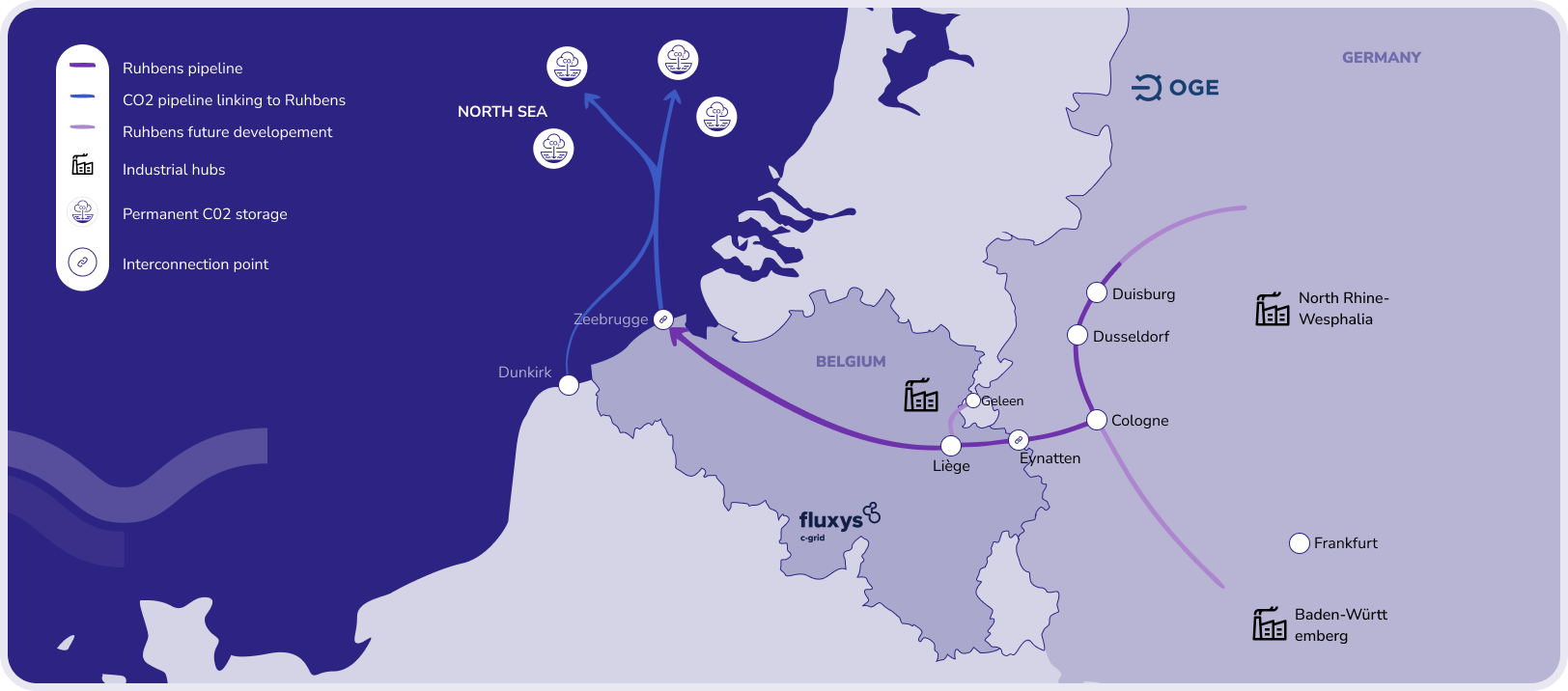
Ruhbens – short for Ruhr, Belgium, North Sea – is a project to establish a vital CO₂ route connecting German industrial areas to the Zeebrugge export hub, unlocking access to multiple permanent geological storage sites in the North Sea.
Ruhbens will cement Belgium's status as a European CO₂ transport and export crossroads with connections to permanent storage sites – connections that are both direct and interoperable with Northern Europe's CO₂ infrastructure.
An open-access, scalable CO₂ corridor contributing to industrial decarbonisation
Ruhbens will act as a major artery linking the Ruhr and Rhine industrial areas to the Belgian CO₂ transport backbone currently under development.
The facilities will enable:
- CO₂ captured in Germany to be transported to the Belgian border;
- the transported CO₂ to be fed into the Belgian CO₂ network operated by Fluxys c-grid;
- onward transportation to Zeebrugge, as the future terminal for exports via pipeline to offshore storage sites;
- multi-site access to the North Sea storage facilities, ensuring flexible volumes and integration with other European offshore corridors, in particular with the CO₂ Highway Europe and CarbonConnect projects, with a view to permanent storage of CO₂.
This multi-access approach means that Ruhbens will be able to offer a unique level of flexibility, enabling it to meet industry's growing carbon capture and storage (CCS) needs.
Ruhbens in figures
-
500 km of CO₂ pipelines in Germany and Belgium
-
Up to 20 million tonnes of CO₂ transported each year, with the ability to expand to other industrial areas as the market develops
-
By the early 2030s, operation based on market demand
Fluxys, a key player in the Belgian CO₂ corridor
Through its subsidiary Fluxys c-grid, which was appointed as the CO₂ network operator for Wallonia in July 2025 and for Flanders in October 2025, Fluxys is playing a key role in the development of the CO₂ transport backbone. This infrastructure, fully accessible to all industrial players, will enable captured volumes to be transported to Zeebrugge and offshore storage facilities.
In this way, Fluxys is pursuing its ambition to:
- become a key partner in the energy transition;
- provide open-access, safe and competitive infrastructure;
- develop a CO₂ transport capacity that could reach 30 million tonnes per year over the next decade.
Project supported by the European Union
The German and Belgian sections of the Ruhbens corridor have been recognised by the European Union as projects of common interest (PCIs) in connection with the EU2NSEA project.

The contents of this publication are the sole responsibility of Fluxys c-grid and OGE, and do not necessarily reflect the opinion of the European Union.