Activities
CO₂ infrastructure for industrial decarbonisation
As a key infrastructure partner, we want to accelerate the energy transition with infrastructure for different molecules. We aim to offer customers an annual transport capacity of 30 million tonnes of CO₂ in the 2030s.
To achieve this, CO₂ networks must be interconnected across industrial clusters and countries through integrated infrastructure, including maritime export terminals and offshore pipeline corridors.
Step-by-step development
Joint development
Since early 2021, we have been preparing the necessary CO₂ infrastructure in cooperation with industry, partners, government authorities, operators and other stakeholders across the regions where we operate and beyond, including key industrial clusters and maritime hubs in North-West Europe, to enable competitive decarbonisation CO₂ export routes. We are doing everything we can to offer our customers the first transmission capacity for CO₂ as soon as the market is ready.
In line with needs
We are developing transmission infrastructure for CO₂ in line with the needs of industry and regional, national and European initiatives aimed at strengthening the energy market and accelerating the energy transition.
Building an interconnected system
We are planning connections between industrial areas, countries and export hubs in order to build the CO₂ networks into integrated systems.
Focus on competitive tariffs
Thanks to the interconnections, we aim to offer high-capacity infrastructure at competitive rates thanks to the scale effect.
Enabling competitive industrial decarbonisation
We are laying the foundation for industrial decarbonisation in Northwest Europe by shaping an interoperable CO₂ network with cross-border connections benefitting from Belgium’s strategic position within an integrated European CO₂ transmission system.

The CO₂ network: Belgium links industry to storage

Focus on Belgium
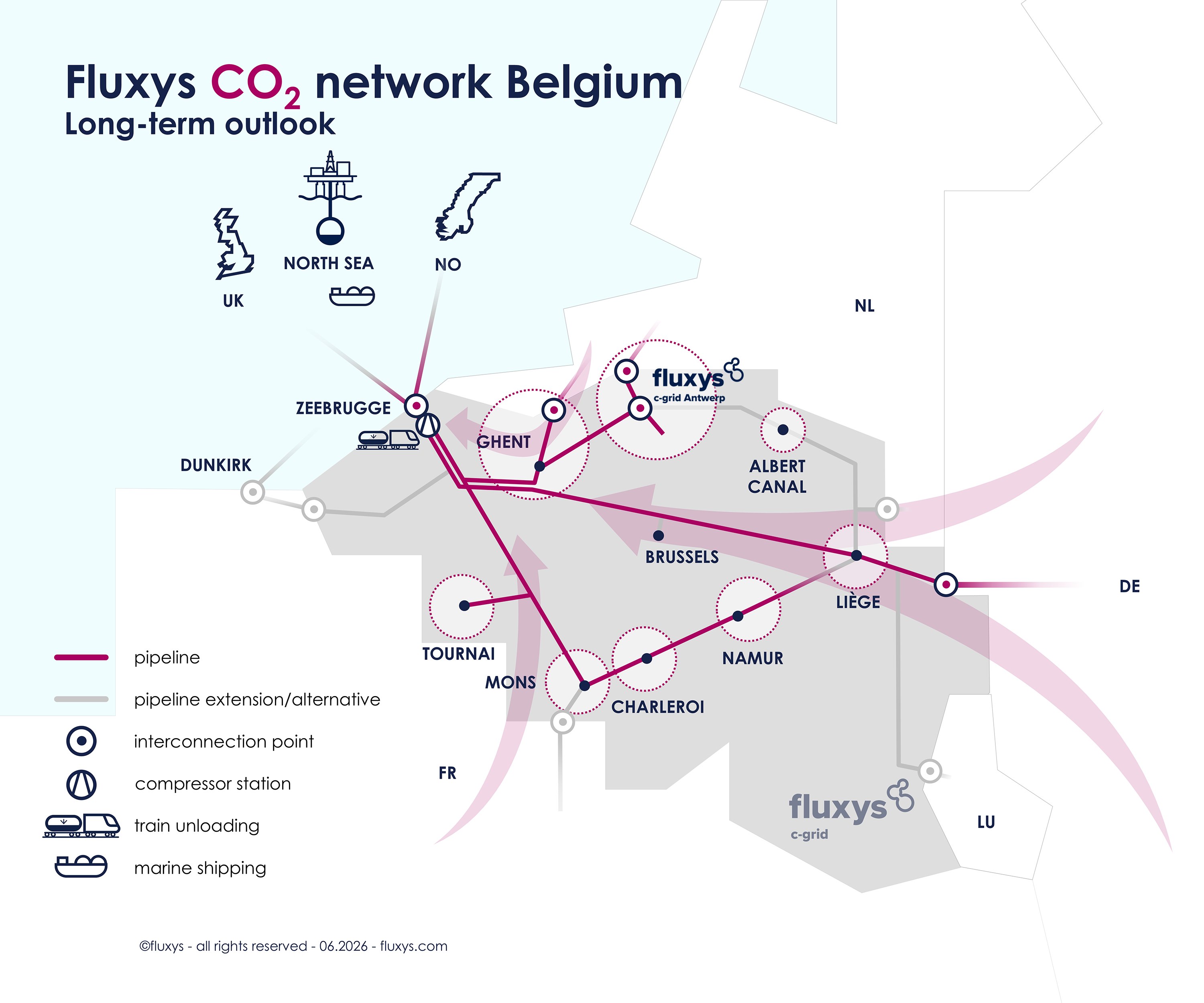
Long-term vision CO₂ network:
Belgium as a hub for CO₂ transit and export
Activities in development
CO₂ demand and supply levels in specific clusters need to be matched. Via mutual exchanges between different interested parties (suppliers and offtakers) several promising infrastructure proposals are launched.