Building the CO₂ infrastructure for decarbonising Europe
Building Europe’s CO₂ transport backbone
Achieving climate neutrality in Europe requires large-scale solutions to manage carbon emissions that cannot be avoided. Carbon capture, transport and storage (CCS) is essential for industries that emit CO₂ as a process emission if they are to become climate neutral. These industries, often referred to as "hard-to-abate", cannot (significantly) reduce CO₂ emissions from their operations by electrifying their processes or by using green or low-carbon molecules; sectors where it is difficult to reduce CO₂ emissions include, for example, the steel, lime and cement industries.
CCS will play a critical role in securing Europe’s pathway to net zero and in avoiding the relocation of investments and jobs to other regions. As an international energy infrastructure group, Fluxys is developing an open-access CO₂ infrastructure that connects industrial clusters to various export solutions (via pipeline or ships) and give them further access to safe and permanent storage sites. By working closely with industrial partners, authorities and peer infrastructure operators, we help turn CO₂ capture into a realistic and efficient decarbonisation option at a European scale.
Europe’s emerging CO₂ value chain
The European Commission, in its industrial carbon management strategy, estimates that by 2040 up to 280 million tonnes of CO₂ will need to be captured annually, increasing in 2050 to 450 million tonnes of CO₂ to reach climate neutrality. By then, around 200 million tonnes are expected to be reused, while 250 million tonnes will need to be transported to permanent storage sites. To support this ambition, the Net-Zero Industry Act sets a target of 50 million tonnes of annual CO₂ storage capacity by 2030.
Europe is now moving from ambition to implementation. In 2025, the first full-scale industrial CO₂ capture, transport and storage chain entered operation in Norway, demonstrating that cross-border CCS is technically and operationally feasible. At the same time, multiple additional projects across Europe are progressing towards final investment decisions, step by step laying the foundations of a European CO₂ market.
Our role in Europe’s CO₂ infrastructure
Together with our subsidiaries Fluxys c-grid and Fluxys c-grid Antwerp, we are working closely with industry to develop the CO₂ infrastructure needed to transport captured CO₂ from industrial sites to export or reuse solutions.
In 2025, construction started on the first CO₂ transport infrastructure in the Antwerp port area, laying the foundation for a larger interconnected CO₂ network. This infrastructure is designed as an open-access system, enabling multiple industrial players to connect and scale over time.
Beyond Belgium, Fluxys is contributing to the development of regional and cross-border CO₂ corridors, aligning industrial clusters, transmission infrastructure and offshore storage in the North Sea region and beyond. This includes projects such as Ruhbens, an initiative aimed at developing cross-border CO₂ transport infrastructure linking industrial regions in North-West Europe to permanent storage capacity, thereby supporting the emergence of an interconnected CO₂ value chain. By connecting industrial emitters to carbon transport and storage solutions, these projects help accelerate decarbonisation across Europe.
Creating viable market conditions
Like hydrogen, the CO₂ market is at an early stage of development. As a first mover, infrastructure operators play a decisive role in enabling this market to emerge and develop. By connecting CO₂ capture sites to export options which give in turn access to storages, they build the backbone that allows industrial players to act and invest with confidence.
Our infrastructure is designed to unlock this new ecosystem: by offering open access to customers, we enable emitters to quickly decarbonise and support the gradual build-up of capacity across the value chain.
At the same time, we actively contribute to the development of a clear and supportive regulatory framework. Across Europe, market rules for CO₂ transport are taking shape, while Belgium is already leading the way. In 2024, Flanders and Wallonia adopted dedicated decrees for CO₂ transport, establishing the foundations of the legal framework required to accelerate project implementation and stimulate market development.
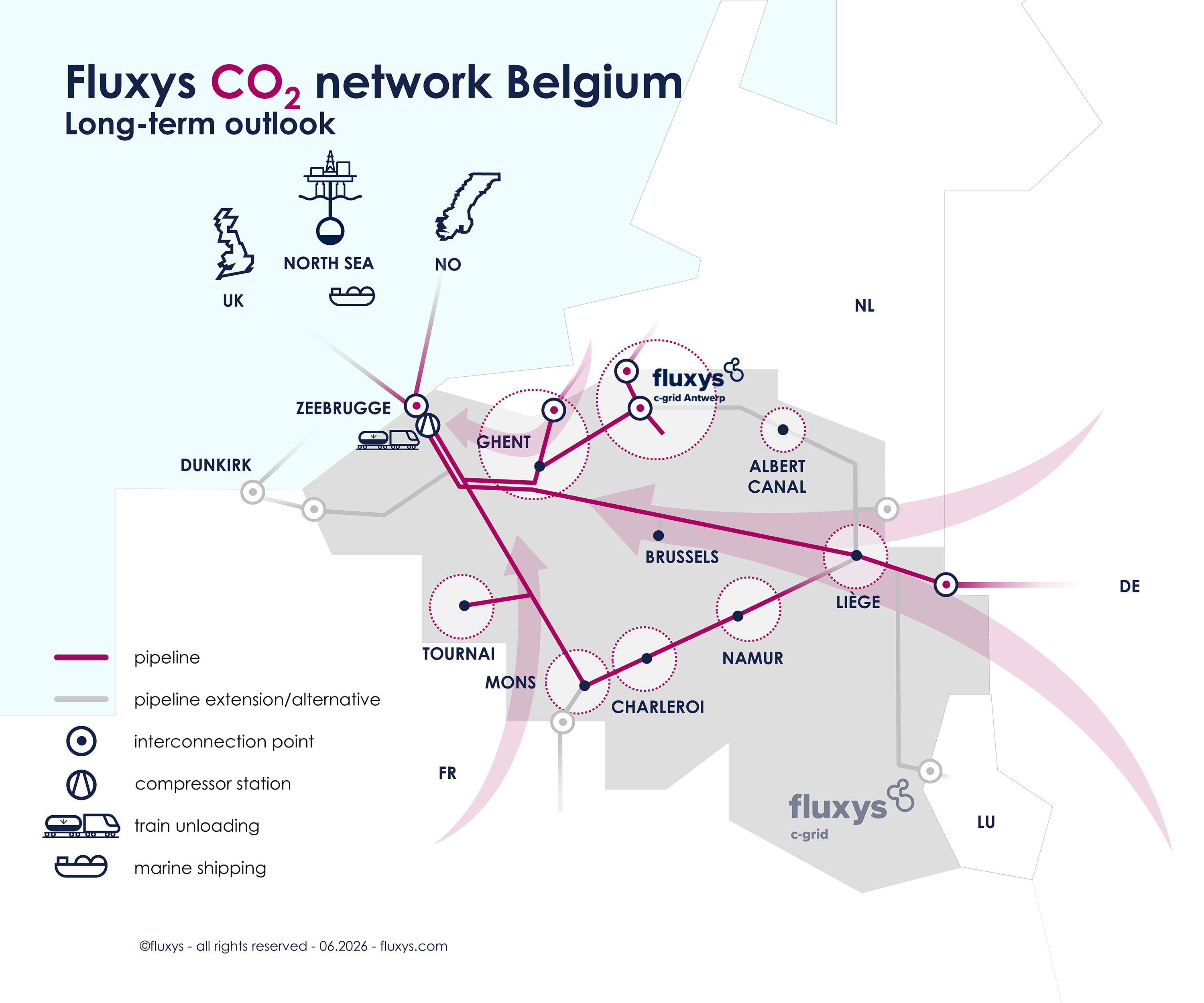
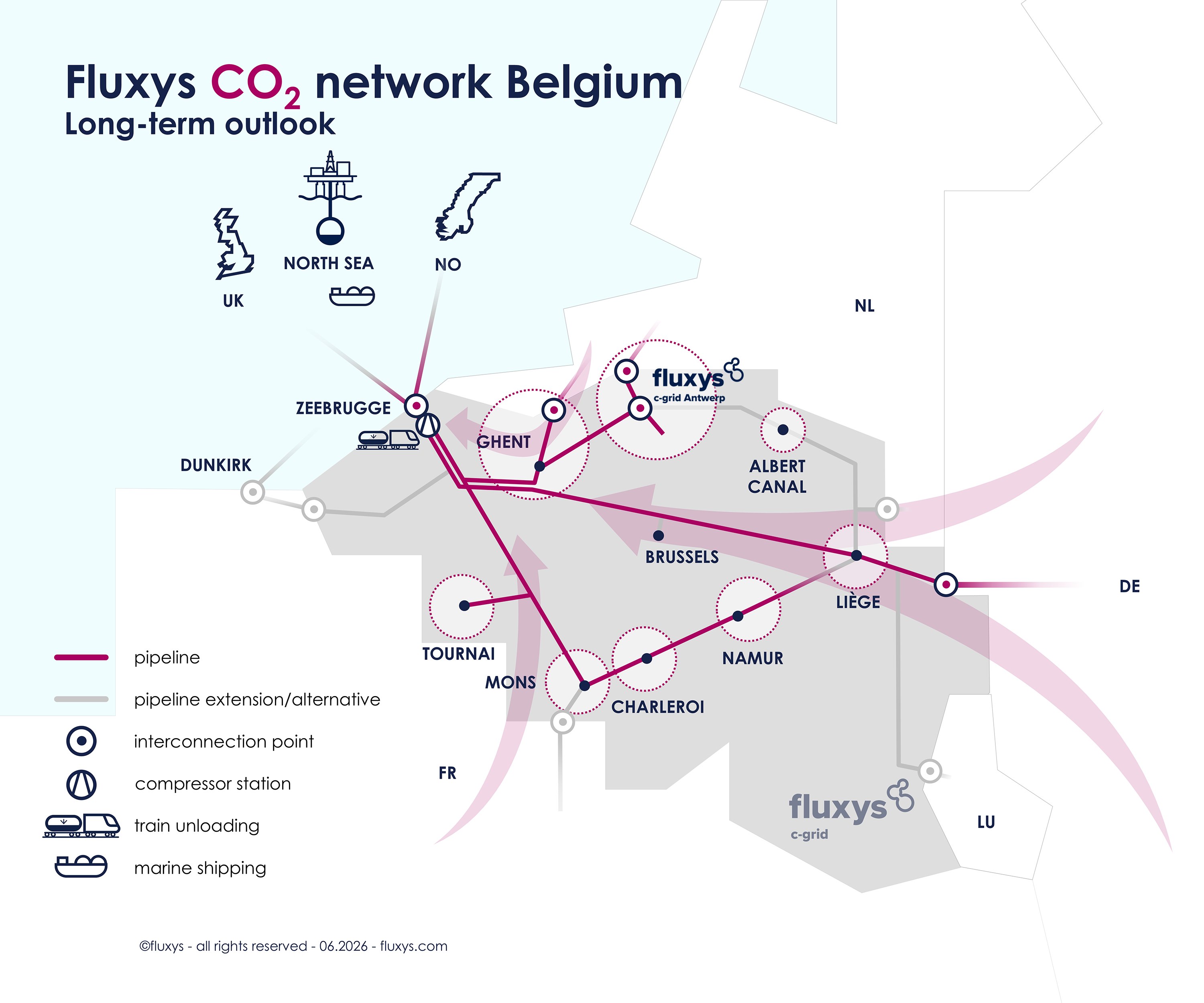
Connecting industry to Europe’s climate ambitions
By developing CO₂ infrastructure that is open-access, scalable and interconnected at European level, Fluxys helps bridge the gap between climate ambition and industrial reality. Our approach supports:
- Industrial decarbonisation at scale
- Cross-border cooperation between actors in the CO₂ value chain
- A framework that supports long-term investment in an emerging market
- A cost-efficient and fair transition for industry
Through partnerships, infrastructure development and regulatory engagement, we are helping to decarbonise Europe, molecule by molecule.
- Fluxys c-grid AntwerpVerbinden Sie sich mit dem CO₂-Transportnetz im Hafen von Antwerpen